Publications
publications by categories in reversed chronological order. generated by jekyll-scholar.
2026
-
 GLACIER: A Multimodal Student-Teacher Foundation Model for Molecular Property PredictionEmily Nguyen, Yongchan Hong, Harsh Toshniwal, Yan Liu, and Andreas LuttensKnowledge Discovery and Data Mining (KDD), 2026
Deep learning models facilitate the discovery of molecules with tailored properties among billions of candidate compounds. However, the computational burden to develop and deploy state-of-the-art models continuously increases, limiting their scalability. Most large-scale models are unimodal in nature and overlook the potential to leverage complementary molecular data modalities. To address these shortcomings, this paper introduces the Graph-Language Alignment for Chemical Inference and Exploration using Representations (GLACIER) model, a student-teacher framework that integrates molecular graphs, SMILES strings, and physicochemical descriptors to learn rich molecular embeddings. Our framework consists of three stages: (1) we pretrain three student encoders on 100,000 drug-like molecules: a message-passing neural network for molecular graphs, a transformer-based encoder for SMILES strings, and a multilayer perceptron for physicochemical descriptors, (2) we fuse these student modalities using a novel Finsler geometry-aware module, and (3) distill complementary knowledge from large teacher models, including MiniMol and MolFormer, into a single lightweight model via contrastive learning. We demonstrate that GLACIER is a robust framework that delivers high predictive performance and computational efficiency in complex molecular property prediction tasks. Our code is publicly available at https://github.com/eemokey/glacier
-
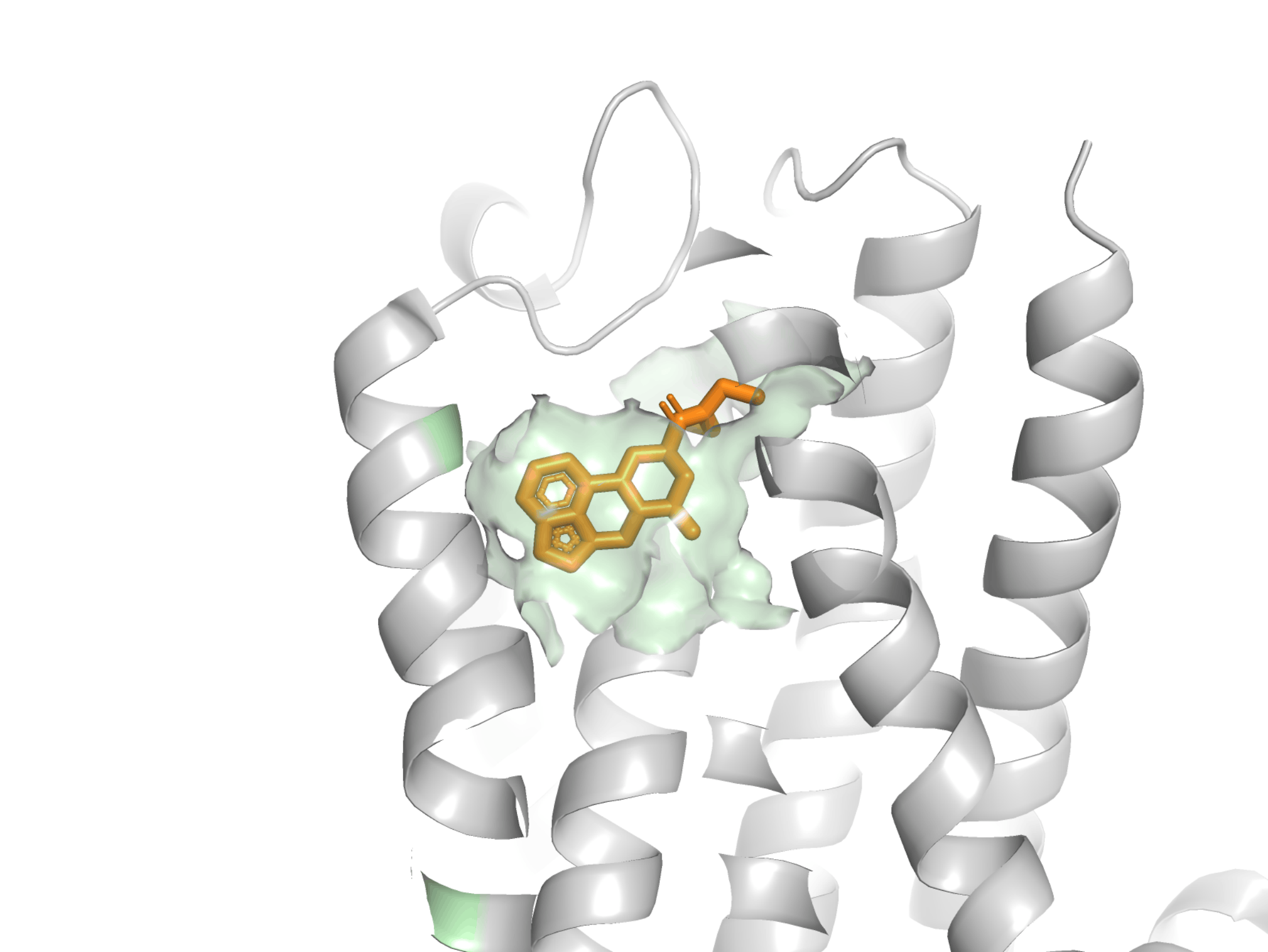 Trustworthy Protein-Ligand Binding Affinity Prediction via Reliability-Aware Multi-Engine FusionYongchan Hong, Defu Cao, Wenjin Liu, Thomas Ku, Jordy Homing Lam, Emily Nguyen, Willie Neiswanger, Vsevolod Katritch, and Yan LiuKnowledge Discovery and Data Mining (KDD), 2026
Accurate protein-ligand binding affinity prediction is central to computational drug discovery, yet modern docking engines frequently disagree without indicating which prediction to trust. Consensus scoring and ensemble methods improve mean accuracy but treat all predictions identically without interpretable confidence measures or uncertainty decomposition, ignoring the chemical context of each protein-ligand pair. To address this limitation, we introduce RELIABLE-BA (RELIABiLity-aware Evidential fusion for Binding Affinity), an evidential framework for multi-engine binding affinity prediction. Our model comprises three steps: (1) modeling each engine as an evidential expert via Normal-Inverse-Gamma distributions, (2) scaling epistemic uncertainty through learned reliability from molecular context while preserving each expert’s predictive mean, and (3) fusing experts through closed-form aggregation that captures both individual uncertainty and inter-engine disagreement. Experiments on the PDBBind and BDB2020+ benchmarks demonstrate competitive point prediction with substantially improved uncertainty calibration, and additional validation on the SARS-CoV-2 Mpro dataset and 5HT2A receptor demonstrates applicability to clinically relevant drug targets. Crucially, these uncertainty estimates enable reliable filtering of protein-ligand pairs, reducing prediction error by up to 25% when retaining only high-confidence pairs. To our knowledge, RELIABLE-BA is the first multi-engine binding affinity prediction framework to combine evidential fusion with context-dependent reliability, offering a principled path toward trustworthy AI-guided drug discovery. Our code is publicly available at https://github.com/yongchand/RELIABLE-BA


2023
-
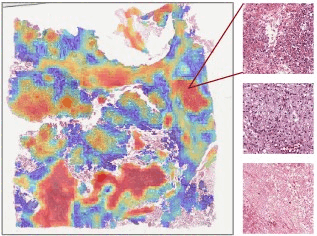 Transferable and Interpretable Treatment Effectiveness Prediction for Ovarian Cancer via Multimodal Deep LearningEmily Nguyen, Zijun Cui, Georgia Kokaraki, Joseph Carlson, and Yan LiuAmerican Medical Informatics Association Symposium (AMIA), 2023
Ovarian cancer, a potentially life-threatening disease, is often difficult to treat. There is a critical need for innovations that can assist in improved therapy selection. Although deep learning models are showing promising results, they are employed as a "black-box" and require enormous amounts of data. Therefore, we explore the transferable and interpretable prediction of treatment effectiveness for ovarian cancer patients. Unlike existing works focusing on histopathology images, we propose a multimodal deep learning framework which takes into account not only large histopathology images, but also clinical variables to increase the scope of the data. The results demonstrate that the proposed models achieve high prediction accuracy and interpretability, and can also be transferred to other cancer datasets without significant loss of performance.

2022
-
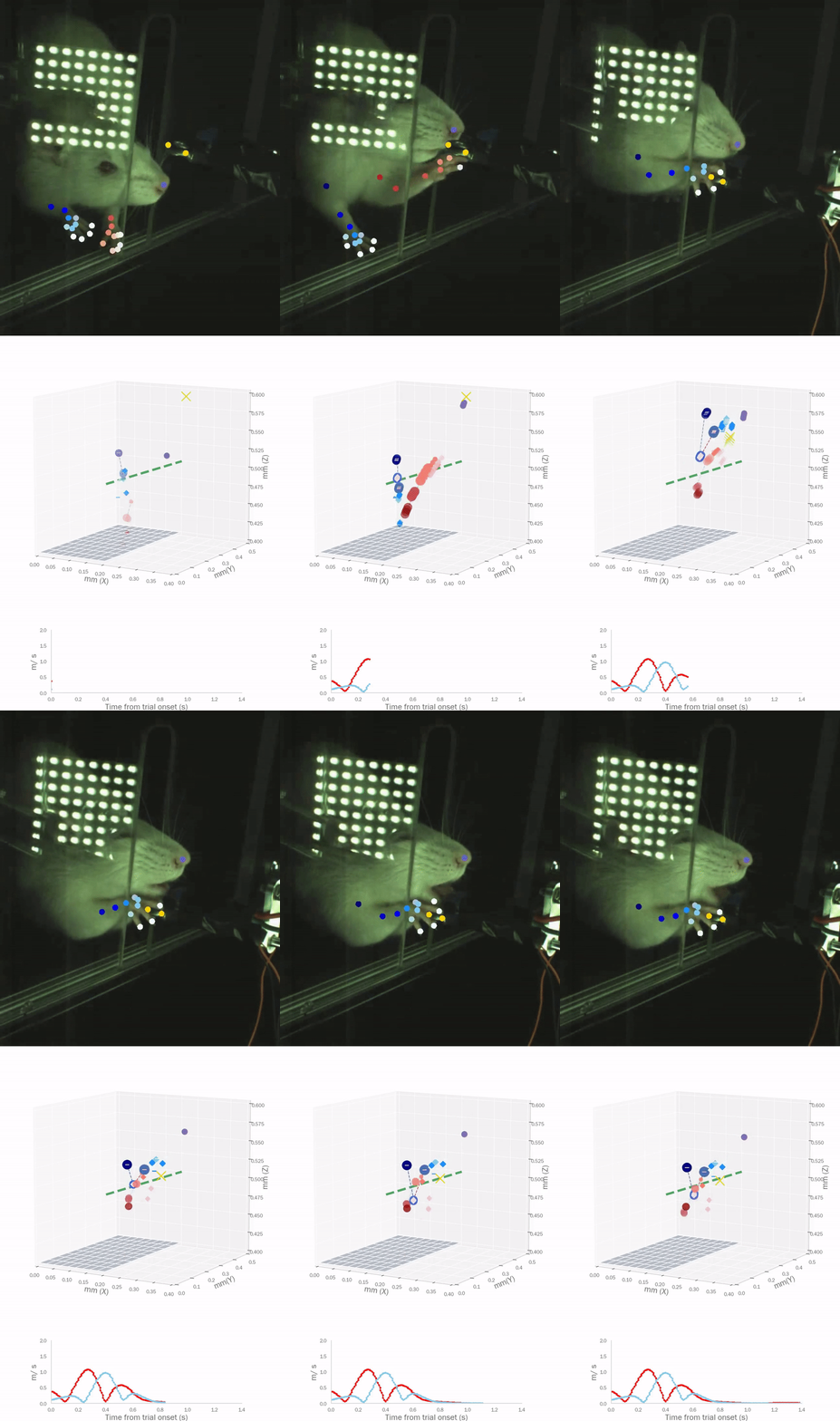 Machine Learning Methods for Supervised Classification of Behavioral Time Series DataEmily NguyenUniversity of California, Berkeley, Department of Electrical Engineering and Computer Science (B.A. Honors Thesis), May 2022
Quantitative analysis of continuously recorded behavioral data entails both classification and segregation of the constituent unique behavioral phenotypes to avoid potential confounds. Current methods utilize human or sensor-based annotation to perform this task. A deep learning approach using supervised classification is developed to automate this time-consuming process, predicting unique hierarchical behavioral phenotypes with high accuracy. Additionally, network ensembles are utilized to enhance the robustness and accuracy of supervised classification, as well as to identify potential outliers when using the classifier in the field.

2021
-
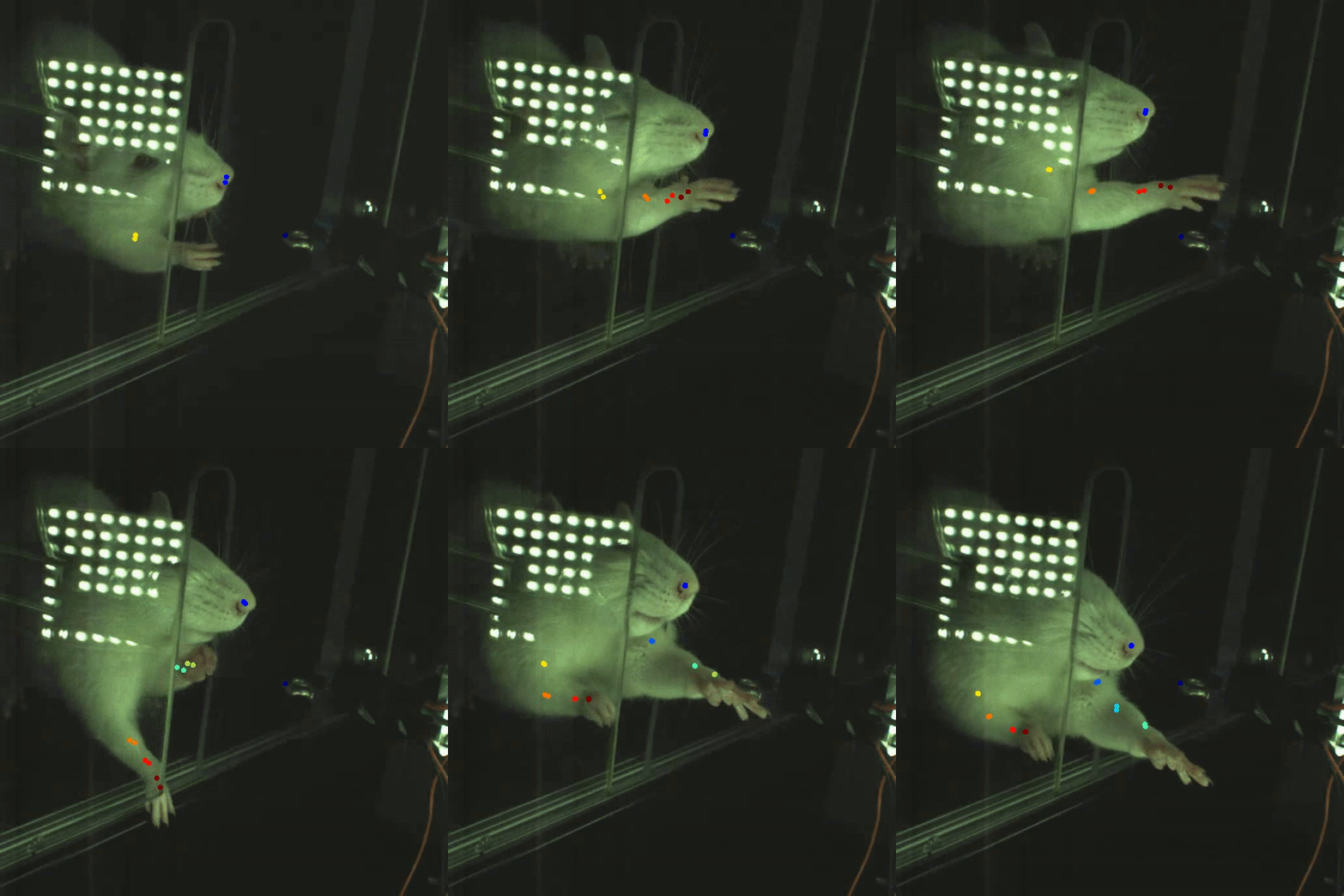 ReachMaster-3D: An Experimental Platform for Precise 3D Measurement of Whole-Arm Kinematics During Freely-Behaving Reaches in RatsBrett Nelson, Shafeeq Ibraheem, Emily Nguyen, and Kristofer BouchardSociety for Neuroscience (SfN), May 2021
Reaching is an essential behavior occurring in three dimensions (3-D). Rodents perform dexterous reaching behaviors, however rodent reaching has mainly been quantified during low-dimensional behavioral tasks and resulting kinematic measurements are not-in 3-D. There exists a need for behavioral assays, using high-dimensional tasks, to measure whole-arm reaching kinematic variables in 3-D during freely-behaving reaching. Here we present ReachMaster-3D, a novel assay capable of measuring reaching 3-D kinematics from freely-behaving male rats reaching to a handle varied in position from 0 to 3 task dimensions. We examine measures of task performance and effect of task complexity on trajectories and velocities extracted using the ReachSplitter-3D system. We then use 3-D kinematic variables within current motor control models to quantify the effects of task dimension on kinematic variability. ReachMaster and the accompanying ReachSplitter3D library produce robust (<4mm) 3-D kinematic (position, velocity, acceleration) predictions across 27 unique whole-arm and body segments during continuous reaching experiments in an unsupervised manner. To perform this task we developed a behavioral classification pipeline to classify and finely segment reaching behaviors using supervised learning. Using as inputs 3-D kinematics and accompanying sensor data from the ReachMaster assay into a set of pre trained random forest classification algorithms that separate out unique reaching phenotypes at sub-millisecond temporal resolution, we show that ReachSplitter-3D reliably distinguishes between behavioral subtypes during reaching. We then present a model that performs event detection and segmentation within our high-dimensional time-series datasets. We analyze resulting segmented kinematics across similar reaching classes using trajectory minimization and second-order feedback control models across two unique task paradigms. Our central hypothesis is that modulation of task dimension structures variability in the 3-D kinematics of rodents. Our current research extends the current understanding of freely-behaving rats reaching in 3-D task environments, necessary for modern translational research in kinesiology and neurophysiology of reaching that seeks to fully rehabilitate or restore natural reaching behavior in humans. Our future research will seek to uncover cortical surface representations of kinematic variables during reaching in rodents utilizing the novel research methods shown.
